
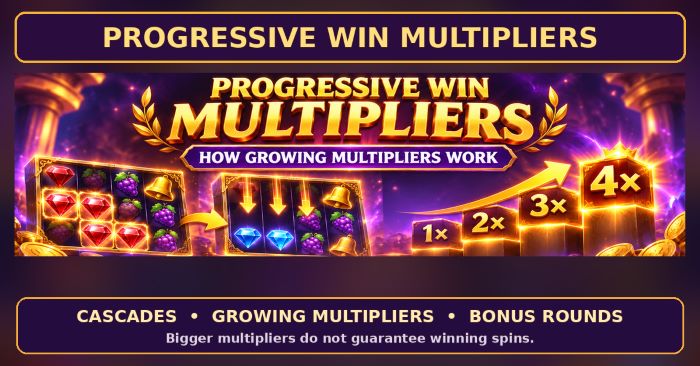
To help illustrate my point, here is another progressive multiplier experience that was a major turning point for me — this happened during a bad run of a Bonanza Megaways free spins round. At first, the free spins were terrible. five or six dead spins followed by some small reactions, and the multiplier slowly climbed to about 6x. Then came the spin that changed everything: seven or eight times in a row. Each response increased the multiplier by one, and each subsequent win was won at the multiplier value. A round that had seemed unproductive now paid way more than did the last hour of play in the base game.
To summarize, a progressive multiplier isn’t just there to pay off one big win. It’s designed to allow you to collect a series of smaller wins as well. For that reason alone, they can create games that feel amazing one session and brutal the next. Once you’ve learned how progressive multipliers function, you’ll better be able to determine which games fit within your budget, what information the rule screen is providing you with and why a growing multiplier cannot ever guarantee a certain outcome.
Win multiplier basics
A slot machine win multiplier is simply a multiplier that you earn for your win. With a 2-coin win and a 3x win multiplier, your win would be 6 coins. Simple enough. A progressive win multiplier is a multiplier that increases in value while a game feature is active. Like all progressive multipliers, the trigger may vary depending upon the game being played. The trigger may include things such as; a cascade of wins, consecutive wins, free spins, the collection of symbols, or a symbol with a multiplier value that increases a total running multiplier. What qualifies it as “progressive” is that it retains its value from One win to the next. A 4x win multiplier that you earned remains intact until you earn your next win.
Compare that to other types of multipliers. A fixed multiplier is always the same value and typically results from a wild card that always doubles whatever lines it completes. Random multipliers appear randomly with an unknown value on a particular spin and disappear once the spin is completed. Progressive multipliers retain memory and therefore accumulate value throughout the course of a sequence of wins. While sequences may consist of a single spin’s chain of cascades or an entire free spins round, the key takeaway is that progressive multipliers allow you to earn money more consistently than do non-progressive multipliers.
How do progressive win multipliers grow?
While stripping away theme elements shows that virtually every progressive win multiplier slot utilizes One of a handful of engines, two of the most popular are; cascade counters & additive multiplier symbols.
Cascade counter engines
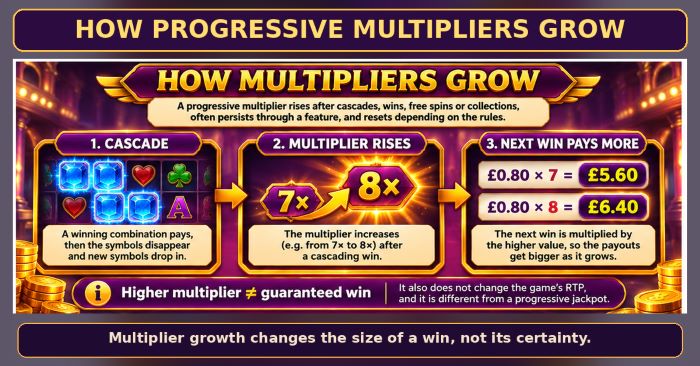
In this type of engine, winning symbols are eliminated from the board and replaced by new ones. Each successful reaction causes the multiplier to advance to the next step. While some slots utilize a +1 (i.e., 1x, 2x, 3x, 4x etc.) progression scheme for their multiplier counter, others follow a predetermined progression path (e.g. I.e., 1x, 2x, 3x, 5x). Gonzo’s quest represents the ultimate progression-based multiplier slot. During both its base and free-fall modes, Gonzo’s Quest employs an avalanche-style counter mechanism in which the avalanche multiplier advances in increments of 1x, 2x, 3x, 5x, 9x, 15x, and so on.
Additive multiplier symbol engines
With this type of engine, special symbols land on the reels with specified values associated with them. Those values are then added to a total and utilized as a multiplier for future wins. The best-known example of this type of engine is found in Gates of Olympus. During its free-spins mode, any multiplier orb that lands on the reels during a winning tumble sequence is added to a total multiplier that continues to climb throughout the remainder of the free-spins round.
Position/symbol-based growth engines
This type of engine assigns a specific location or symbol on the reels as the source of the multiplier. As mentioned earlier, Sugar Rush allows players to mark locations on the reels as winners explode. Subsequent hits on those same locations result in doubling the existing multiplier at that location. Similarly, Jammin’ Jars assigns the multiplier to a wild jar symbol. Each additional hit on that symbol increases the multiplier by +1.
Collection/level-up engines
This type of engine requires players to collect items and complete certain requirements prior to earning an upgraded multiplier. In Big Bass Bonanza Megaways’ free spins mode, for instance, collecting fisherman wilds awards additional free spins and upgrades the player to larger multipliers for each subsequent fish caught.
Tumble sequences/cascade chains
Regardless of what name is used to describe it (avalanche, reaction, tumble) – cascade-based mechanics are essentially identical across all platforms. In brief:
- Winning symbols are removed;
- Symbols from above drop down to replace them;
- New winning combinations occur when applicable;
- If new combinations occur, this process repeats itself;
Thus, a single paid spin can generate numerous wins. All Three types of cascading multiplier slots employ similar mechanisms to link a multiplying effect to a tumble sequence. In Gonzo’s Quest’s base mode, for example, if an initial paid spin generates four consecutive cascades, the fourth winning spin occurs at x5. Meanwhile, Bonanza Megaways and Extra Chili Megaways are two examples of slots that possess no base-game multiplier whatsoever; however, they do provide an increasing multiplier effect during their respective free-spins modes. Specifically, every reaction in Bonanza Megaways earns +1 to the existing multiplier. In either case, regardless of which mechanism is employed, the key factor is understanding what happens to the cascade chain at its conclusion. Does it reset? Are there limitations on how much it can grow?
Global vs local multipliers
There exists considerable confusion regarding global multiplier symbols (gm), multiplier bombs (mb), and local multiplier symbols (lm). It is helpful to define each term precisely:
A multiplier symbol (ms) refers to any reel symbol that includes a value (an orb, bomb or a wild with “x3” printed on it); however, ms does not specify whether or not said value will remain intact post-win.
A multiplier bomb (mb) refers specifically to a themed ms; mbs typically explode when they land or detonate at the end of a tumble sequence and apply their value at that time.
A global multiplier (gm) applies to the total winnings generated by a spin or sequence (as opposed to applying solely to individual winning lines/clusters).
Local multiplier (lm) applies solely to the individual winning lines/clusters in which it participates.
Examples of popular progressive multiplier slots
Some slots are worth noting due to their ability to demonstrate various flavors clearly.
Gonzo’s Quest (NetEnt) is the forefather of cascading-multiplier slots. Due to its cascade-reset feature following every paid spin, Gonzo’s Quest possesses less variance than newer titles; thus, it serves as an excellent platform to develop your understanding of how cascade-chains operate.
Bonanza Megaways & Extra Chili Megaways (Big Time Gaming) serve as prime examples of how a pure +1 per reaction free-spins multiplier works and persists throughout the duration of a round.
Gates of Olympus & Starlight Princess (Pragmatic Play) employ additive multiplier symbols with values ranging from 2x up to 500x. In free-spins modes, these values accumulate into a running total; consequently, large rounds on these games tend to rapidly escalate in terms of value towards their conclusion.
Sweet Bonanza (Pragmatic Play) is an excellent contrasting example; people commonly believe Sweet Bonanza operates similarly to Gates; however, Sweet Bonanza does not. During Sweet Bonanza’s free-spins mode, multiplier bombs possessing values from 2x up to 100x land and add together and apply to that sequence’s total win; however said multiplier bombs do not persist into subsequent spins; therefore a sequence that earns 2x your bet with a 5x and 25x bomb on screen results in earnings totaling 60x and then the slate is wiped clean. Sweet Bonanza provides an example of random multiplier with stacking additives rather than a true progressive-free-spins multiplier.
Great Rhino Megaways & Big Bass Bonanza Megaways (Pragmatic Play) conclude our list by providing examples of climb-tumble multipliers and collection-based level systems, respectively.
Based upon my personal experience with many slot machines, I strongly advise testing any slot machine in demo mode before wagering real money on it. The majority of today’s slot machines are available in instant play form via HTML5 technology allowing users to test games without having to download software first. twenty minutes spent playing in demo mode will likely teach you more about the rhythm of a multiplier than will reading any number of reviews on this subject. Observe how frequently features trigger, how frequently the feature actually triggers on subsequent spins, and observe how many rounds end with relatively modest payouts.
Whichever game(s) you choose to play with real money, please establish a deposit limit, loss limit and/or session limit prior to commencing play; not after losing money in one particularly frustrating round. Games classified as high-volatility are designed to produce lengthy periods devoid of wins; therefore, chasing “One more bonus” using a growing multiplier may become increasingly appealing. Should gaming stop becoming entertaining for you, please visit GamCare.org.uk (gambling care), begambleaware.org.uk (be-gambl-aware), or gamblersanonymous.org.uk (Gamblers Anonymous) for free confidential counseling assistance.
Frequently Asked Questions
What is a progressive win multiplier?
A progressive win multiplier is a multiplier that increases as you play in features of some slot games (like cascading wins or free spins), and it keeps growing for subsequent wins.
How does progressive multiplier work in slots?
Progressive multipliers are triggered by qualifying events. In most cases, they increase the multiplier each time an event occurs. The trigger can vary depending on the game rules.
How are progressive multipliers triggered?
Some common ways include; cascading or tumbling wins, consecutive wins, winning with multiplier symbols while playing a feature, hitting the same space multiple times in a row, or filling up a symbol collection to start a special feature.
Are progressive multipliers ever reset?
Yes, usually. Most of the time, progressive multipliers reset either every single time a player has a paying spin, or only once the free spins round is over.