
Why the wrapper still matters
A lot of people think slots are interchangeable. But they’re not. Every single one of them has a wrapper, or a theme. Sometimes the theme is a literal one (like a jungle), and sometimes it’s metaphorical (like “the search”). Either way, the theme affects how long someone will spend playing, and how many times they’ll come back to try and win. Slots have the same math inside them — same RTPs, same volatility levels, etc. So if they’re all the same math-wise, why do players choose certain slots over others? The answer lies in the psychology of slot themes.
Psychology of choosing a theme
One big thing about slot themes is escapism. However, there’s a difference between saying a player wants to escape reality while playing slots versus wanting to be transported somewhere else. In other words, a player may prefer to explore a virtual jungle instead of escaping the stress of everyday life. This is important because it points out that themes aren’t just decorations. Themes provide a layer of storytelling that creates an experience, not just a series of numbers. Themes activate more areas of the brain than abstract math problems do. They create associations, memories, and excitement based on images and ideas that evoke feelings in addition to generating random numbers.
Nostalgia is another huge factor. Many adventure and mythology-themed slots rely heavily on references to stories and myths that were absorbed by children decades ago. From pulp adventure serials to Saturday morning cartoons featuring Greek heroes to picture books about pyramids and pharaohs, players’ brains are already primed for these types of stories. Developers know this, so they use existing mythologies to create an instant emotional connection for their players. Using familiar elements helps create a shortcut to creating an engaging experience with the player. While an original theme could potentially achieve the same effect eventually, it wouldn’t happen until the player had experienced the theme several times. This shortcut provides immediate gratification and encourages the player to continue playing.
Then there’s the element of thrill of the chase. Almost every slot theme includes some form of pursuit. Whether it’s hunting for treasure or finding lost cities, the chase aspect of these themes refocuses a session. Instead of thinking “I’m placing bets,” players now think “I’m trying to find something.” Players typically enjoy activities that involve pursuit more than they enjoy repeating themselves over and over again. As such, designers that understand this concept generally build the entire game around forward momentum — even though, from a statistical standpoint, the probabilities remain the same from one spin to the next.
Themes: why adventure slots resonate with players
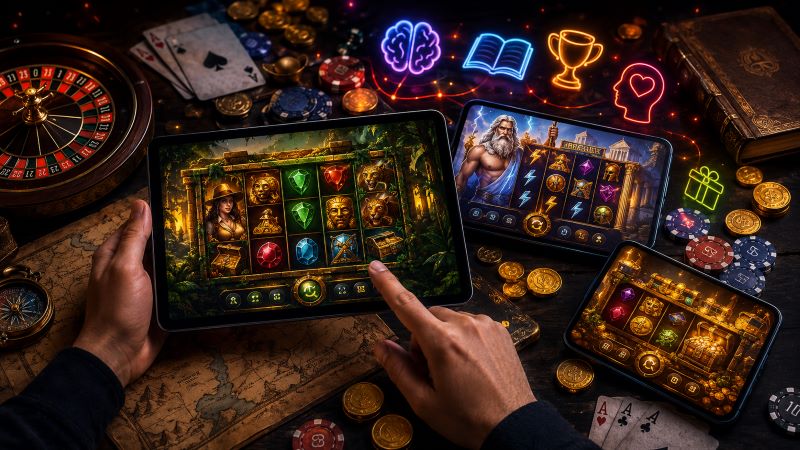
Adventure-themed slot games create an experience that mimics traveling. Each time a player progresses through a level, they’re filling in a map that represents their journey. With each bonus round, they’re exploring more of the jungle or more of the temple. These experiences mimic how humans are programmed to react when discovering something new. For example, why have exploration-based video games remained so popular for nearly 40 years? Slot designers have taken some of the same principles used in these games and applied them to creating slots.
One developer described watching her friend play a jungle-themed slot game and explained that her friend wasn’t looking to hit the jackpot; she was interested in seeing what would be revealed in the next room. That’s interesting because it illustrates how the game transformed her desire for money into a desire to see what happened next. Similarly, jungle adventures, lost temples and buried treasures all utilize an implied advancement — even though the player starts over every time they make a bet. Map quests within bonus rounds represent an effective method of providing players with a sense of direction while maintaining randomness in results.
Instead of having a generic bonus screen that doesn’t relate to previous decisions made during gameplay, players receive a pathway with options that reflect decisions previously made. Even though visually it looks no different from prior random outcomes, the psychological impact is noticeable. By turning each spin into an opportunity to advance through a story — advancing through a story is intrinsically rewarding — adventure-themed games provide players with a much-needed distraction from the monotony inherent in repeated spins.
Gods & Mythology: Power & Drama
Mythology-themed slot games operate in a slightly different psychological realm than adventure-themed slots. Rather than focusing on discovery (which is more typical for adventure games) mythology-themed slots focus on power fantasies. Greek god slots, Norse god slots and Egypt god slots all place the player close to something greater than everyday life. They don’t simply spin reels they ride with Zeus or join Thor in battle against Ragnarok or stand before Ra at the entrance to the underworld. The emotionality of these themes is designed to be high-stakes, and mythology has many benefits in terms of providing that emotionality.
All of these themes come with built-in dramatic situations and identifiable symbols which allows developers to easily add layers of complexity without having to worry about developing complex characters or backstories. This advantage also extends to designing bonus features using mythological structures as many mythologies include escalating challenges that lead up to a climactic showdown making it easy for designers to develop stage-based bonus systems that mirror the structure of their chosen mythology. Additionally, there are advantages in utilizing culturally recognized mythologies. Since most players in Western countries have heard of at least one Greek or Norse or Egyptian god, developers can avoid spending time educating players about their mythology by including simple symbols such as Zeus’ lightning bolt or Thor’s hammer or Anubis’ staff — that immediately convey the scale and significance of the action unfolding.
Gold & Wealth: The Reward Brain
There is a psychological distinction between gold/wealth-themed slots and adventure/mythology-themed slots. Gold and wealth-themed slots create psychological distinctions related to how players view payouts themselves — by taking a payout from simply being a number, and turning it into an object discovered through a story. When a slot presents its bonus feature as “opening a vault”, rather than as “you won a multiplier”, it transforms a mathematical result into a discovery result. Players are no longer simply seeking payouts — they are actively working towards finding hidden treasures throughout a story. This framing increases satisfaction in achieving the same numerical results as other non-narrative styled bonuses.
This relates to something well-understood in behaviorally-oriented research: participants respond more positively to rewards framed as efforts to discover resources than they do identically rewarded passive handouts. A gold coin spilling out of a treasure chest after completing a bonus round is perceived differently from receiving an equal coin value as simply an arbitrary number — despite the fact that the underpinning mathematics has not changed one iota. Treasure-seeking psychology relies heavily on this conceptually, presenting straightforward payout table designs as representations of digging, unlocking or revealing items of value.
Culturally speaking, gold conveys nearly universally recognized symbolic meanings related to value regardless of market or language — making it an extremely efficient visual representation tool. Therefore, designers do not need to justify why gold holds value; virtually everyone learns early on through childhood stories, cultural symbolism and/or basic economic understanding that gold is valuable.
Designing successful thematic integration
While none of this psychology will matter unless implemented effectively via design and sensory experiences, it is at this juncture that the differences between unremarkable adventure slots and truly memorable ones become apparent. A theme is only as compelling as the aesthetic and structural design surrounding it, and this is where slot development typically diverges significantly from mere aesthetics alone where visual appeal is relevant but secondary to soundtrack/atmosphere considerations that influence continued immersion post-session initiation (i.e., 40 minutes).
Ambient audio is capable of affecting players even when their conscious attention is focused elsewhere (on television programming, phone usage etc.). Interactive bonus mechanisms provide perhaps the best intersection between theme and game mechanics. For example, a well-designed map quest bonus mechanism provides two functions simultaneously: it generates randomized math-based results necessary for the game’s operation while reinforcing the narrative construct supporting continued immersion throughout the session.
Likewise collection mechanisms that accumulate symbols across multiple spins toward some eventual payout demonstrate analogous logic by enabling players perceive accumulation/progression toward some ultimate objective (or destination) rather than perceiving individual spins as discrete events devoid of context.
However, there exists substantial design tension regarding successful thematic implementation worthy of honest discussion. The stronger the thematic narrative framing employed by designers for their game(s), the higher the expectations for the narrative-framed bonus round created subsequent thereto. Conversely, while a beautifully themed slot game with weak/barebones bonus mechanisms can elicit disappointment in players expecting to engage in an equally large-scale narrative experience with Odin during its bonus round (for instance), it is reasonable to assume that poorly designed mechanics can also diminish enthusiasm for games that appear more aesthetically appealing overall than less-visual games (e.g., candy-themed cluster-pays).
Consequently, design teams should consider themes as setting expectations for players — i.e., promising players an immersive experience. Mechanisms must then meet or exceed these expectations; failure to do so can render players disappointed due to a perceived disconnect between expectation and delivery (not indifferent).
Session Length & Retention: Theme Integration
Both Session Length & Player Retention are similarly correlated with how well a theme integrates its mechanics and continues to present cohesive visuals & narrative constructs throughout its gameplay sequence (from Base Game to Bonus Feature). Slots whose Base Games & Bonus Features share common visual/aesthetic identities will likely retain player attention for extended periods relative to slots whose Base Games & Bonus Features do not share common identities. Players are aware of this incongruence — even if unable to articulate precisely why an initially satisfactory Bonus Round was subsequently less enjoyable.
As such, designers who prioritize thematic integration throughout their games’ various aspects (color palette/sound effects/pacing of animation sequences) ensure that each spin never feels as though it has departed from the world established by their Base Game.